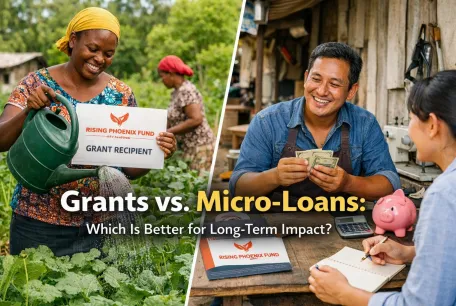
Grants vs. Micro-Loans: Which Is Better for LongTerm Impact?
Grants vs. Micro-Loans: Which Is Better for LongTerm Impact?
Hey there, and welcome back to our series, The $100 Impact. If you’ve been following along, you know we’re obsessed with a simple question: How can a relatively small amount of money: the kind many of us spend on a nice dinner or a pair of sneakers: actually change a life halfway across the world?
In our last post, we talked about Beatrice, a resilient market vendor in St. Lucia. When the cruise ships stopped docking during the height of the COVID-19 pandemic, her income didn’t just dip; it vanished. Like so many women in the tourism-dependent Caribbean, Beatrice was left holding a basket of goods with no one to buy them.
When we talk about helping women like Beatrice, a big debate always comes up in the world of social impact: Grants vs. Micro-Loans.
Is it better to just give the money away as a gift (a grant), or is it better to lend it (a micro-loan)? At Rising Phoenix Fund, we’ve spent a lot of time thinking about this. We want to make sure every dollar our donors give does the absolute most good.
Let’s break down the "Why" and the "How" of these two models and see which one really wins when it comes to long-term impact.

First, let’s talk about grants. A grant is a direct gift. No strings attached, no repayment required. In the world of non-profits, grants are the "emergency room" of funding.
Grants are fantastic for:
• Immediate Relief: If a hurricane wipes out a market stall, a grant provides the cash to rebuild right now.
• Specific Startup Tools: Sometimes a vendor just needs one big thing: like a new industrial refrigerator or a sewing machine: to get started.
• Vulnerable Moments: For women who are in extreme poverty or recovering from a crisis, the pressure of a loan can be too much.
However, grants have a "one-and-done" problem. Once a $100 grant is spent, it’s gone. To help the next woman in line, the organization has to go out and find another $100. It’s a constant cycle of fundraising that can be hard to sustain.
The Case for Micro-Loans: The Revolving Door of Hope Now, let’s look at micro-loans. This is the model we lean into at Rising Phoenix Fund, especially when we talk about our revolving funds.
A micro-loan isn’t about making a profit off someone’s struggle. Instead, it’s about creating a sustainable cycle. Here’s how it works:
1. The Initial Push: We provide a small loan: let's say $100: to a woman entrepreneur like Beatrice.
2. The Investment: She uses that money to buy bulk inventory or perhaps a small cart to move her goods closer to where the locals shop (since the tourists are gone).
3. The Repayment: As she sells her goods and earns a profit, she pays the loan back over a few months.
4. The Cycle Continues: That same $100 is then lent out to the next woman in the community.
This is what we call a Revolving Fund. Your single donation of $100 doesn't just help one woman; it helps five, ten, or twenty over the course of a few years. It turns a one-time gift into a permanent community resource.

Why Micro-Loans Win for Long-Term Impact
When we look at international women entrepreneurs: especially those working as street vendors or in local markets: micro-loans offer three major advantages that grants just can’t touch.
1. Sustainability and Dignity
There is a massive psychological shift when a woman takes a loan instead of a handout. It’s a business transaction. It says, "I believe in your ability to grow your business and pay this back." It builds confidence. For women in St. Lucia who have spent years being dependent on the unpredictable ebbs and flows of the cruise ship industry, having control over their own capital is empowering.
2. Building a Financial Track Record
Many of the women we work with are "unbanked." They don't have credit scores or formal banking histories. By successfully managing and repaying a micro-loan, they prove they are reliable. This can eventually open doors to larger, formal loans that can help them grow from a street stall to a permanent storefront.
3. The Multiplier Effect
In the grant model, if we have $1,000, we can help 10 women once. In our revolving loan model, that $1,000 can support 10 women this year, another 10 next year, and so on. The money stays in the community. It keeps working. It’s the ultimate way to maximize the impact of every donor dollar.
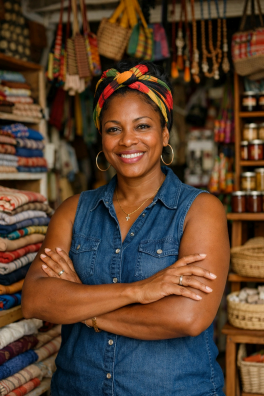
Lessons from St. Lucia: Beyond the Cruise Ships
Let’s go back to the street vendors in St. Lucia. For decades, the local economy was built around the cruise ship schedule. When the ships were in, the markets were buzzing. When the ships left, the money left with them.
COVID-19 taught us that this level of dependence is dangerous. When the tourism industry collapsed overnight, these women had no safety net. Many had to pivot to selling essentials like vegetables and soap to their own neighbors instead of souvenirs to tourists.
This pivot requires capital. A micro-loan allows a vendor to change her business model quickly. It gives her the flexibility to adapt to a changing world. When she pays that loan back, she isn’t just helping herself; she’s ensuring her neighbor: who might also be struggling to feed her children: has access to that same pool of capital.
The Family Ripple Effect
We focus on women because the "ripple effect" is real. Statistics show that women reinvest up to 90% of their income back into their families. When a market vendor in St. Lucia makes an extra $20 a week because of a micro-loan investment, that money goes directly to:
• School uniforms and fees.
• Better nutrition for her kids.
• Home repairs (which are crucial in hurricane-prone areas).
By supporting the mother’s business through a revolving fund, we are effectively investing in the education and health of the next generation. It’s a long-game strategy.
How You Can Help
At Rising Phoenix Fund, we believe that simple solutions are often the most effective. You don't need to be a billionaire to change the world. In fact, most of our impact comes from "micro-donors": people who give what they can, often under $1,000.
Your $100 contribution can be the spark that starts a revolving fund. It can be the reason a woman like Beatrice can buy her first bulk shipment of produce, allowing her to lower her costs and increase her take-home pay. And because of our model, your $100 will still be out there, working in the community, long after you’ve forgotten you even gave it.
Ready to start the cycle?
Donate to Rising Phoenix Fund Now
The Bottom Line
So, which is better: Grants or Micro-Loans?
Grants have their place in emergencies, but for long-term, sustainable, community-wide change, micro-loans are the clear winner. They respect the entrepreneur, they stay in the community, and they grow over time.
When you support a woman through a revolving fund, you aren't just giving her a fish: or even teaching her to fish. You're helping her buy the boat, and ensuring that once she's caught enough, she can pass the boat to the next woman on the shore.
Thank you for being part of this journey. Together, we’re proving that $100 can indeed change everything
Stay tuned for our next post in "The $100 Impact" series, where we’ll dive deeper into the specific challenges of the St. Lucia vendor community and how they are rebuilding their lives one market day at a time.
Rising Phoenix Fund Inc. is a non-profit dedicated to empowering international women entrepreneurs through sustainable financial models. Learn more about our work at risingphoenixfund.org

